Many parents notice that their children understand basic math but take a long time to complete simple calculations. The challenge is often not a lack of ability. Children may simply need more practice with number visualization, concentration, calculation patterns, and mental arithmetic.
Abacus training gives children a structured way to develop these skills. Instead of relying only on written calculations, children learn to work with an abacus and gradually build the ability to visualize it mentally. With regular practice, this can help them become more comfortable with numbers, improve calculation speed, and approach math problems with greater confidence.
For families exploring abacus classes, the goal is not simply to make children calculate faster. A well-structured program can also support concentration, memory, visualization, logical thinking, and independent problem-solving.
What Is Abacus Training?
An abacus is a calculation tool made up of movable beads arranged on rods. Children learn how numbers are represented on the abacus and use specific finger movements to perform calculations.
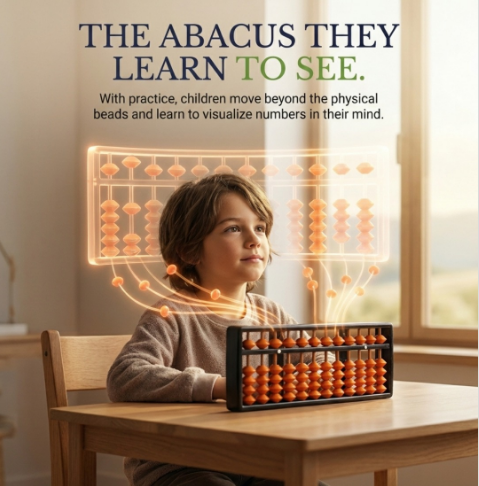
At the beginning, the physical abacus provides a visual and hands-on way to understand numbers. As children become more familiar with the techniques, they can begin visualizing the beads in their minds and perform calculations without physically moving them.
This transition from physical calculation to mental visualization is an important part of abacus learning. It encourages children to picture numbers instead of depending entirely on paper, fingers, or calculators.
AbacusMaster Canada describes its program as a structured mental math program for children aged 6 to 13, with progressive levels designed to develop calculation and cognitive skills step by step.
How Does Abacus Help Children Calculate Faster?
Speed in mathematics usually develops through understanding, repetition, and familiarity with numbers. Abacus training combines these elements through structured exercises.
Here are several ways the method can support faster mental calculation.
1. Children Learn to Visualize Numbers
One of the most distinctive parts of abacus learning is visualization.
A child first sees the beads and learns how different positions represent different numbers. With practice, the child starts creating a mental picture of the abacus.
For example, instead of thinking about a calculation only as written numbers, the child may begin imagining the movement of beads while solving it mentally.
This gives children another way to process mathematical information. Over time, repeated visualization exercises can make basic calculations feel more familiar and automatic.
The ability to visualize numbers is particularly useful when children begin working with longer calculations because they are developing a mental representation rather than depending completely on physical materials.
2. Repetition Builds Calculation Fluency
Children do not become quick at mathematics simply by learning one technique. They need opportunities to practise it repeatedly.
Abacus programs typically introduce concepts gradually, allowing children to practise a particular calculation method before moving toward more difficult problems.
AbacusMaster Canada’s program includes eight progressive learning levels, with students moving from basic calculation concepts toward more advanced mental calculations.
This type of progression matters because children can strengthen one skill before adding another. Instead of giving a beginner complex problems immediately, the learning process builds familiarity step by step.
Regular practice can also help children become less hesitant when they see numbers.
3. Mental Arithmetic Encourages Independent Thinking
Mental arithmetic means solving calculations without relying on paper, a calculator, or another external aid.
For children, this can become an exercise in holding information in their minds while working through a problem.
A simple calculation may require the child to remember one number, apply a mathematical operation, visualize the next step, and arrive at an answer. As problems become more difficult, children have to manage several pieces of information at once.
That makes mental math practice useful beyond the individual calculation.
Children are learning to process information, follow a sequence, and check their thinking. These habits can support their general approach to mathematical problems.
4. Concentration Becomes Part of the Learning Process
Fast calculation is difficult when a child loses focus after every few seconds.
Abacus exercises require children to pay attention to numbers, bead positions, instructions, and calculation sequences. A small mistake can affect the final answer, so children learn that careful attention matters.
The AbacusMaster Canada program specifically highlights concentration, memory, visualization, and analytical thinking as areas supported through its approach.
This does not mean every child will develop the same skills at the same rate. Children have different learning styles and starting points. However, regular structured practice gives them repeated opportunities to work on sustained attention.
5. Memory and Visualization Work Together
Mental calculation requires children to keep information in their minds while completing a task.
When children practise visualizing an abacus, they are not simply memorizing answers. They are learning to remember positions, movements, and calculation sequences.
For younger learners, this can make math practice more interactive than repeatedly copying equations from a worksheet.
The combination of memory and visualization is especially relevant as children progress toward mental calculations. The physical abacus gradually becomes less necessary as the child becomes more comfortable imagining the movements.
What Can Children Learn Through an Abacus Program?
A quality program should have a clear learning progression rather than presenting random calculation exercises.
Source : https://www.instagram.com/abacusmastercanada_ss/reel/Ddg0G9CD6Uq/
AbacusMaster Canada’s published program is divided into beginner, intermediate, and advanced stages. Beginner levels introduce basic number understanding and calculation techniques. Intermediate levels introduce larger numbers and multiplication and division, while advanced levels move toward complex calculations performed mentally.
This type of progression can help parents understand what their child is working toward.
Beginner Stage
At the beginner stage, children become familiar with the abacus, numbers, finger movements, and basic addition and subtraction.
The priority is understanding the method rather than chasing speed immediately. Children need enough time to become comfortable with the tool and the rules before they can use the techniques confidently.
Intermediate Stage
As children gain experience, calculations can become more complex.
They may work with larger numbers and begin learning multiplication and division. At this stage, accuracy remains important because increasing speed without understanding can lead to repeated mistakes.
Regular practice allows children to become more familiar with calculation patterns and improve their confidence.
Advanced Stage
At advanced levels, the focus can shift toward mental calculation.
Children begin relying more heavily on visualization instead of physically manipulating the abacus. This is where the mental side of the training becomes particularly noticeable.
The objective is not simply to produce an answer quickly. Children also need to understand the calculation process and maintain accuracy.
Can Abacus Training Help a Child Who Struggles With Math?
Abacus training should not be viewed as a quick fix for every math difficulty.
Children struggle with mathematics for different reasons. Some may have difficulty understanding number concepts. Others may lose confidence, rush through questions, struggle to concentrate, or simply need more opportunities to practise.
An interactive method can give some children a different way to approach numbers.
The physical abacus provides something children can see and touch. Later, visualization gives them a mental method for working with numbers. This combination may make mathematical practice feel more concrete for children who find traditional written calculations difficult.
Parents should also look for a program where instructors can identify the child’s current level and provide appropriate guidance rather than expecting every student to progress at exactly the same pace.
Abacus Classes Online or In Person?
Parents today have several options for children’s enrichment programs.
AbacusMaster Canada offers online classes across Canada as well as in-person and hybrid learning options. Its online format uses instructor-led sessions, while in-person classes provide structured classroom learning and hands-on practice.
Online Abacus Classes
Online learning can be convenient for families with busy schedules or limited access to a nearby learning centre.
Children can attend instructor-led sessions from home and continue practising between classes. Parents should consider the child’s ability to stay focused during online sessions and whether the program provides sufficient interaction and feedback.
In-Person Abacus Classes
In-person learning gives children direct interaction with an instructor and other students.
For some children, being physically present in a classroom makes it easier to stay engaged and maintain a regular learning routine.
Families searching for local options can explore abacus classes in Surrey, abacus classes in Oshawa, abacus classes in North York, or abacus classes in Russell depending on their location.
How Parents Can Support Abacus Practice at Home
Parents do not need to turn home practice into another school lesson.
Short, consistent practice can be easier for children than long sessions that leave them frustrated.
Try creating a quiet practice routine at a predictable time. Encourage your child to complete the assigned exercises carefully and celebrate progress in accuracy before focusing heavily on speed.
Parents can also make numbers part of everyday conversations. Ask children to add small quantities, compare numbers, estimate totals, or solve simple mental calculations during ordinary activities.
The purpose is to make mathematical thinking feel familiar rather than something that only happens during a class.
What Should Parents Look for in an Abacus Program?
Choosing a program involves more than finding the first class available nearby.
Parents can ask a few practical questions before enrolling.
Is There a Clear Learning Structure?
A structured curriculum helps children progress from basic concepts to more advanced skills.
Look for clearly defined levels, regular practice, and an explanation of what children are expected to learn at each stage.
Are Instructors Providing Individual Guidance?
Children do not all learn at the same speed.
Instructor feedback can help identify mistakes, reinforce techniques, and prevent children from practising incorrect methods repeatedly.
Is There Regular Practice?
Abacus learning requires consistency. Ask how children practise between sessions and whether worksheets, videos, exercises, or other learning materials are provided.
AbacusMaster Canada lists interactive practice videos, worksheets, assessments, performance tracking, and personalized instructor guidance among its program features.
Can Parents Try a Class First?
A demonstration class can help parents and children understand how the teaching method works before making a longer commitment.
AbacusMaster Canada currently promotes a free demo class for families interested in its program.
How Quickly Can a Child Improve Mental Math?
There is no single timeline that applies to every child.
Progress depends on factors such as age, previous math experience, consistency of practice, concentration, understanding of the techniques, and the child’s individual learning pace.
Parents should avoid measuring success only by how many calculations a child can complete in a minute.
Accuracy, confidence, understanding, concentration, and willingness to attempt problems are also useful indicators.
Speed usually becomes more meaningful when it develops alongside accuracy. A child who rushes and makes frequent mistakes is not necessarily progressing more effectively than a child who takes slightly longer and consistently reaches the correct answer.
Could Abacus Be a Useful Math Enrichment Activity?
For parents looking beyond standard homework, abacus can provide a structured way to practise mathematical thinking.
It can combine calculation, visualization, memory, concentration, and repeated problem-solving in one activity. AbacusMaster Canada also positions its program as a math enrichment option that goes beyond standard curriculum skills.
The biggest advantage for a child may simply be becoming more comfortable with numbers.
When children gain confidence in their ability to approach a calculation, they may be more willing to attempt challenging questions rather than immediately assuming that a problem is too difficult.
Frequently Asked Questions
1. What age is suitable for abacus classes?
AbacusMaster Canada designs its programs for children aged 6 to 13. However, the right starting point can depend on a child’s readiness, attention span, and comfort with basic numbers.
2. Can abacus training improve mental math?
Abacus training is designed to help children progress from physical bead calculations toward mental visualization. With regular practice, children can develop skills related to mental arithmetic, number visualization, accuracy, and calculation speed.
3. Is online abacus learning effective for children?
Online abacus classes can provide instructor-led learning from home. The effectiveness depends on factors such as the child’s engagement, the quality of instruction, regular practice, and the level of interaction provided during lessons.
4. How often should children practise abacus?
Consistent practice is more useful than occasional long sessions. Parents can follow the practice schedule provided by the instructor and encourage short, focused sessions between classes.
5. How can parents know if abacus is right for their child?
A demo class can be a practical starting point. It allows parents to see how the child responds to the teaching method, how comfortable they are with the abacus, and whether they enjoy the learning process.
Give Your Child a Chance to Explore Mental Math
Learning mathematics does not have to be limited to worksheets and textbook exercises. Abacus training gives children a hands-on method for working with numbers and gradually develops mental visualization.
For some children, the biggest change may be faster calculations. For others, it may be greater confidence, improved concentration, or a stronger willingness to work through challenging problems.
If you are considering structured abacus and mental math training for your child, starting with a demo class can help you understand whether the program matches your child’s learning needs.
A few minutes of practice each day can become a meaningful part of a child’s mathematical routine when the learning environment is structured, engaging, and appropriate for their level.