As Canadian families continue to place greater emphasis on strong foundational skills, online abacus learning has emerged as an effective way to support children’s mathematical development. More than just an extracurricular activity, structured abacus training helps children strengthen numeracy, concentration, visualization, and problem-solving skills during their formative years.
Across Canada, parents are increasingly looking for educational programs that go beyond memorization and help children develop a deeper understanding of numbers. This shift has contributed to the growing popularity of online abacus classes, which combine flexibility with a proven methodology for mental math development.
At Abacus Master Canada, students learn through a structured 17-rod abacus system that gradually guides them from physical counting to advanced mental visualization. Through consistent practice and level-based progression, children build confidence in mathematics while strengthening important cognitive skills that support success across many academic subjects.
Understanding Online Abacus Learning
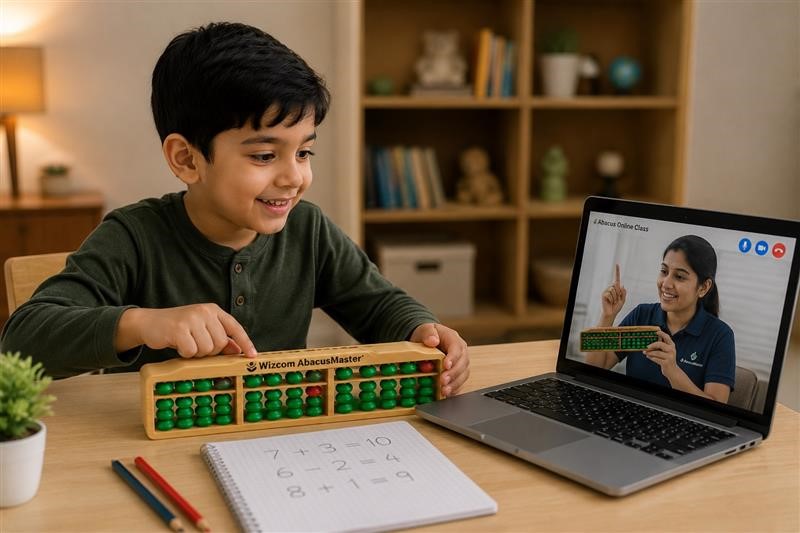
Online abacus learning is designed to help children develop strong mental arithmetic skills through visualization. Students begin by learning calculations using a physical 17-rod abacus and gradually transition toward solving problems mentally by visualizing bead movements.
Unlike traditional approaches that often rely heavily on memorization, abacus training encourages children to understand how numbers work. This creates stronger number sense and improves their ability to perform calculations quickly and accurately.
Because abacus classes are delivered online, students can participate from home while still receiving structured instruction from trained educators. This makes it easier for families across Canada to access high-quality mental math education regardless of their location.
Why Canadian Families Are Choosing Online Abacus Programs
Canadian parents are becoming increasingly aware that early numeracy skills play a significant role in long-term academic success. Research in education consistently shows that children who develop strong number sense in their early years often perform more confidently when learning advanced mathematical concepts later in school.
Many families are seeking educational programs that complement classroom learning rather than simply providing additional homework support. Abacus training fills this gap by helping children develop stronger mental processing skills and mathematical confidence.
Online learning has also become a preferred option for many Canadian households because it offers flexibility without sacrificing educational quality. Families can maintain consistent learning routines while avoiding travel time and scheduling challenges. For parents seeking structured learning opportunities in Ontario, programs such as abacus classes in North York provide students with access to the same proven methodology used throughout the Abacus Master Canada network.
How Online Abacus Classes Work
The learning journey follows a carefully structured progression that allows children to build skills gradually without becoming overwhelmed.
Students typically begin by learning:
- Number recognition
- Basic arithmetic concepts
- Proper abacus handling techniques
- Bead movement and calculation methods
As their confidence grows, they advance to more complex calculations and visualization exercises. Eventually, children learn to picture the abacus mentally and solve calculations without physically using the device. This progression helps strengthen concentration, working memory, and mental processing speed while making mathematical thinking more intuitive.
The 17-Rod Abacus System and Mental Visualization
One of the unique aspects of Abacus Master Canada’s program is its use of the 17-rod abacus system. The purpose of the abacus extends beyond simple counting. It serves as a visual learning tool that helps children develop a mental image of numbers and mathematical operations.
As students advance through the curriculum, they learn to visualize bead movements internally. This process activates multiple areas of the brain simultaneously and encourages stronger connections between visual memory and numerical reasoning.
Over time, children become capable of performing increasingly complex calculations mentally while maintaining both speed and accuracy. This visualization-based approach is one reason many parents notice improvements not only in mathematics but also in focus, listening skills, and classroom participation.
Benefits of Online Abacus Classes for Children
Parents often enroll their children in abacus programs because they want to improve math skills. However, the benefits frequently extend beyond arithmetic.
Regular abacus practice helps children develop:
- Stronger concentration
- Improved working memory
- Better attention to detail
- Faster information processing
- Greater confidence in problem-solving
- Enhanced logical thinking skills
These abilities support learning across multiple academic subjects and help children approach challenges with greater confidence. Many students who initially struggle with calculations begin to develop a more positive relationship with mathematics after participating in structured abacus training.
Why Strong Number Sense Matters Beyond Elementary School
Strong number sense is one of the most important foundations for future mathematical success. Children who develop a deep understanding of numbers during Grades 1 to 5 often find it easier to transition into more advanced topics such as:
- Fractions
- Decimals
- Ratios
- Algebraic reasoning
- Multi-step problem solving
- Financial literacy concepts
Rather than relying solely on formulas, these students are able to understand mathematical relationships and apply logical thinking to new situations. This is one reason many educators emphasize numeracy development during the elementary years. Early skill development creates a stronger platform for future academic achievement.
Accessibility for Families Across Canada
One of the major reasons online abacus learning continues to grow across Canada is accessibility. Families living in major cities often have access to various educational programs, but those in smaller communities may have fewer options for specialized numeracy training. Online classes help bridge this gap by providing equal access to structured instruction regardless of location.
Whether a family lives in a large urban centre or a smaller community, students can participate in the same curriculum and receive consistent guidance from trained instructors.
This accessibility has made online abacus learning particularly valuable for families seeking educational enrichment outside traditional classroom settings. For example, parents looking for abacus classes in Russell can benefit from both local support and online learning opportunities while following the same structured curriculum.
Supporting Canada’s Diverse Learning Communities
Canada is known for its multicultural communities and diverse educational needs. Children come from a wide variety of backgrounds, learning styles, and academic experiences. Structured abacus programs provide a flexible learning environment that accommodates these differences while maintaining consistent educational standards.
Because abacus learning focuses on visual understanding rather than language-heavy instruction, many students find the methodology engaging and easy to follow. This makes it particularly effective for supporting diverse learners across different regions of the country.
Age-Based Learning Progression
A major advantage of structured abacus education is that learning progresses according to a child’s developmental stage.
- Ages 6–7: Foundation Stage: Students begin by learning number concepts, basic calculations, and proper abacus techniques.
- Ages 8–10: Visualization Development: Children strengthen mental imagery skills and begin performing calculations with greater speed and accuracy.
- Ages 11–13: Advanced Mental Arithmetic: Students tackle more advanced mathematical operations including multiplication, division, fractions, HCF, and LCM while relying increasingly on mental visualization. This gradual progression allows children to build confidence while developing strong mathematical foundations.
How Technology Enhances the Learning Experience
Modern technology has made it easier than ever to deliver engaging educational experiences online.
Today’s online abacus classes include:
- Live instructor-led sessions
- Interactive learning activities
- Real-time feedback
- Guided practice exercises
- Progress monitoring tools
Parents can remain involved in their child’s learning journey while instructors track development and provide personalized support when needed. This combination of technology and structured instruction creates a learning experience that remains both effective and engaging.
Building Confidence Through Consistent Practice
Confidence in mathematics rarely develops overnight. Children build confidence when they experience steady improvement and learn to overcome challenges independently.
Through regular abacus practice, students begin noticing that calculations become easier and faster. As they successfully complete new levels and assessments, they gain a sense of accomplishment that encourages continued learning.
Many parents report that their children become more willing to participate in classroom activities and approach mathematical tasks with less hesitation after several months of structured training. This confidence often carries over into other areas of learning as well.
The Important Role Parents Play
Parental involvement remains one of the strongest contributors to a child’s educational success. Children tend to stay more motivated when parents show interest in their progress and encourage regular practice.
Simple actions can make a meaningful difference:
- Establishing a consistent study schedule
- Creating a distraction-free learning environment
- Celebrating progress and achievements
- Encouraging effort rather than perfection
- Communicating regularly with instructors
These habits help reinforce learning while creating a positive educational experience.
Online Learning with Local Community Support
One of the strengths of Abacus Master Canada is its ability to combine online learning with local community engagement. Families interested in abacus classes in Oshawa or abacus classes in Surrey can benefit from structured programs that follow the same proven curriculum while remaining connected to their local learning communities.
This balance of accessibility, consistency, and community support continues to drive interest in online abacus education throughout Canada.
Creating a Strong Foundation for Future Success
The skills developed through abacus learning extend far beyond mathematics. Students learn how to focus for longer periods, think logically, solve problems independently, and approach challenges with confidence. These abilities support academic achievement throughout elementary school and beyond.
As educational expectations continue to evolve across Canada, programs that strengthen both numeracy and cognitive development are becoming increasingly valuable for families seeking long-term learning benefits.
Conclusion
The rapid growth of online abacus classes across Canada reflects a growing awareness of the importance of strong foundational numeracy skills. Parents are looking for educational programs that do more than improve calculation speed—they want learning experiences that strengthen confidence, concentration, and independent thinking.
Through its structured 17-rod abacus methodology, level-based curriculum, and focus on mental visualization, Abacus Master Canada helps students build skills that support both academic performance and lifelong learning.
Whether families are seeking flexible online instruction or support through local learning communities, abacus education continues to offer an effective pathway toward stronger mathematical understanding and cognitive development.
FAQs
1. What are online abacus classes?
Online abacus classes teach children mental arithmetic using a structured 17-rod abacus system. Students gradually progress from physical calculations to advanced mental visualization techniques.
2. At what age can children start learning abacus?
Most children can begin learning abacus concepts between the ages of 5 and 7, depending on their readiness and comfort with basic numbers.
3. How does abacus learning help beyond mathematics?
Abacus training can strengthen concentration, memory, visualization, logical thinking, and problem-solving skills that support learning across many subjects.
4. Are online abacus classes effective?
Yes. With structured instruction, regular practice, and guided progression, many students develop improved accuracy, confidence, and mental calculation abilities.
5. Why are online abacus classes becoming more popular in Canada?
Canadian families value the flexibility, accessibility, and structured skill development offered by online abacus programs, making them an increasingly popular educational choice.