
Five-minute math games can turn everyday number practice into something children actually look forward to. Simple activities involving mental calculation, patterns, memory, and problem-solving can give children regular opportunities to work with numbers without making practice feel like extra homework.
For parents exploring abacus and mental math programs, these short activities can also complement structured learning. The key is to keep the games quick, interactive, and suitable for the child’s age and current math ability.
Why Short Math Games Can Be Useful
Children do not always need a long worksheet session to practise mathematical thinking. A few focused minutes can give them an opportunity to recall numbers, calculate mentally, identify patterns, and explain how they reached an answer.
Short activities are also easier to fit into a family routine. Parents can play them before dinner, during a break, while travelling, or whenever there are a few spare minutes.
The purpose is not to turn every moment into a lesson. Instead, these games can help children become more comfortable thinking about numbers in different ways.
For parents interested in structured learning, abacus classes can provide a more systematic approach to calculation, visualization, and mental arithmetic, while home games can provide additional informal practice.
1. Number Challenge
Choose a number and give your child a series of quick calculations.
For example, start with 20 and ask:
- Add 5.
- Subtract 3.
- Add 10.
- Subtract 7.
- Add 4.
Ask your child to give the final answer without writing anything down.
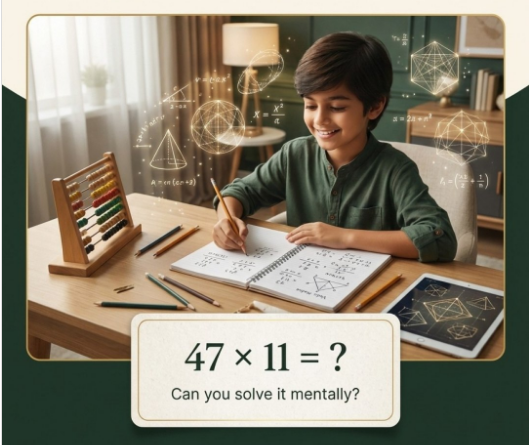
As children become more comfortable, increase the number of steps or use larger numbers.
This game encourages children to hold information in their memory while completing several calculations. It can also help parents notice whether a child tends to lose track during multi-step problems.
Keep the activity relaxed. If your child makes a mistake, ask them to go back to the previous step and try again rather than immediately giving them the answer.
2. Make 10
This is a simple game for younger children who are developing basic number skills.
Give your child a number between 1 and 9 and ask them what number is needed to make 10.
For example:
6 + ? = 10
The answer is 4.
Once the child understands the concept, make it more challenging by using numbers that make 20, 50, or 100.
You can also turn it into a speed game by giving several numbers one after another.
The activity helps children become familiar with number relationships. Instead of calculating everything from the beginning, they gradually recognize combinations more quickly.
3. Mental Math Around the House
You do not need special materials for this game.
Choose ordinary objects around the house and create simple calculations.
For example, if there are 4 books on one shelf and 6 on another, ask your child how many books there are altogether.
Then change the question:
“How many books would there be if we added 5 more?”
For older children, introduce multiplication, division, percentages, or estimation.
This approach helps children see that mathematics is not limited to classroom exercises. Numbers appear in shopping, cooking, time management, household organization, and many other everyday activities.
4. The Missing Number Game
Write or say a simple sequence with one number missing.
For example:
5, 10, 15, __, 25
Ask your child to identify the missing number.
Once they understand the basic concept, make the patterns less obvious:
3, 6, 12, 24, __
Or:
50, 45, 40, __, 30
Ask your child not only for the answer but also for the rule behind the pattern.
This second question is useful because it encourages children to explain their thinking instead of simply guessing the missing number.
5. Beat the Clock
Choose five age-appropriate calculations and give your child a short amount of time to solve them.
The objective should not be to create pressure. Instead, treat it as a personal challenge.
For example, your child might have two minutes to solve five questions. On another day, they can try again and see whether they can complete the same type of questions accurately.
Always put accuracy before speed.
If a child starts rushing and making careless mistakes, slow the activity down. Mathematical fluency develops through understanding and practice, not simply through racing against a timer.
This type of practice can complement the skills developed through abacus and mental math training, where children gradually work toward faster and more confident mental calculations.
6. Mental Shopping Game
Pretend you are shopping together.
Give each item a simple price:
- Apple: $2
- Juice: $4
- Notebook: $6
- Pencil case: $8
Ask your child to choose two or three items and calculate the total mentally.
For older children, introduce a budget.
For example:
“You have $20. You spend $7. How much do you have left?”
Then add another item.
This game introduces practical arithmetic while encouraging children to keep track of several numbers.
It can also be adapted for multiplication. If one notebook costs $4, ask how much three notebooks would cost.
7. Double It
Choose a number and ask your child to double it.
Start with small numbers:
4 → 8
Then increase the difficulty:
15 → 30
25 → 50
45 → 90
Once your child is comfortable, move into a chain:
5 → 10 → 20 → 40 → 80
Ask the child to continue the sequence.
This activity helps children become familiar with multiplication by two and number relationships. It can also lead naturally into multiplication practice.
8. Odd or Even?
Call out numbers and ask your child to identify whether each is odd or even.
Start slowly and then make it quicker.
For an added challenge, give a group of numbers and ask the child to remember how many were even.
For example:
7, 12, 15, 20, 23, 28
The child first identifies the odd and even numbers and then answers how many even numbers appeared.
This combines number recognition with memory.
9. Math Riddles for Kids
Math riddles can make problem-solving feel more like a puzzle.
Try questions such as:
“I am thinking of a number. It is greater than 10 but less than 20. It is even. What numbers could it be?”
Then add more clues:
“My number is greater than 10, less than 20, even, and divisible by 3.”
Now the child has to consider the clues together.
For older children, use multiplication, fractions, percentages, or simple algebra-style riddles.
The goal is not just finding an answer. Encourage your child to explain how they eliminated the wrong possibilities.
10. Memory Math
Say three numbers aloud and ask your child to remember them.
For example:
7, 4, 9
Now ask the child to add the first two numbers.
As they improve, increase the number of values.
You can also reverse the challenge:
“Remember these numbers and tell me the second number.”
This type of activity combines memory with number processing. It can be particularly useful as a short mental exercise because no paper or special equipment is required.
How to Make Five-Minute Math Games More Enjoyable
The best home activities are usually the ones children are willing to repeat.
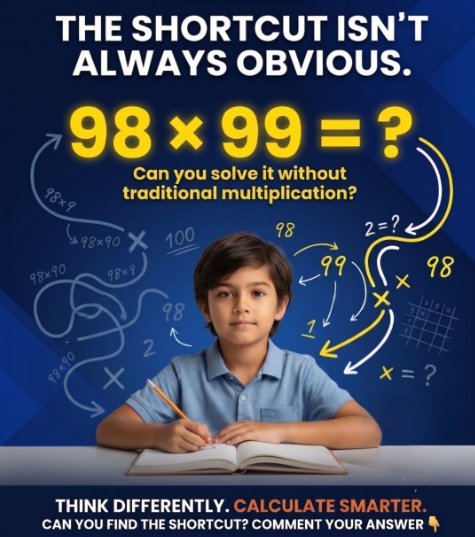
Keep the Sessions Short
Five minutes can be enough.
You do not need to continue until the child becomes tired or frustrated. Ending while the activity is still enjoyable can make it easier to repeat the next day.
Match the Difficulty to the Child
A game that is too easy can become boring, while one that is too difficult can discourage a child.
Start with problems your child can solve successfully and gradually increase the challenge.
Focus on Accuracy First
Avoid making speed the only measure of success.
Ask your child to explain an answer occasionally. If they can solve a problem and explain their reasoning, that gives you more information than a fast guess.
Let Your Child Create Questions
After playing several rounds, switch roles.
Ask your child to create a calculation for you.
Children often enjoy challenging their parents, and creating questions requires them to think about numbers from a different perspective.
Avoid Turning Every Game Into a Test
The purpose is practice and enjoyment.
If your child gets an answer wrong, treat it as part of the game. Ask questions that help them reconsider the calculation rather than making the mistake feel like a failure.
Can Home Math Games Replace Structured Abacus Learning?
Home games and structured classes serve different purposes.
A five-minute activity can provide casual practice with numbers, memory, patterns, and mental calculation. A structured abacus program follows a progressive curriculum and gives children instruction, guided practice, feedback, and increasingly difficult exercises.
AbacusMaster Canada offers progressive abacus and mental math learning for children, with programs designed around skills such as calculation, concentration, visualization, memory, and analytical thinking.
Parents who want a more organized learning path can explore the available abacus learning center options and program information.
The two approaches can work alongside each other. A child can attend structured classes and then spend a few minutes at home playing simple number games.
Local Abacus Classes for Children
For parents searching for a nearby program, AbacusMaster Canada provides location-specific options across Canada.
Families looking for abacus classes in Surrey can explore the Surrey program page for information about local learning options.
Parents searching for abacus classes in Oshawa can visit the Oshawa location page to learn more about the available program.
Families in North York can explore abacus classes in North York and review the local program information.
For families in Russell, the abacus classes in Russell page provides location-specific information.
These local pages can make it easier for parents to move from general research to finding a program relevant to their area.
A Simple Weekly Math Game Routine
Parents who want to make these activities a regular habit can keep the routine simple.
Monday: Number challenge
Spend five minutes giving your child addition and subtraction problems mentally.
Tuesday: Number patterns
Use missing-number sequences and ask your child to explain the pattern.
Wednesday: Mental shopping
Create imaginary shopping lists and calculate totals.
Thursday: Math riddles
Give your child number clues and let them work out the answer.
Friday: Memory math
Give a short sequence of numbers and ask your child to remember and manipulate them mentally.
The activities do not need to be identical every week. Changing the games keeps practice interesting while giving children repeated exposure to different types of mathematical thinking.
When Should Parents Consider an Abacus Program?
If your child enjoys number games and you want to provide more structured practice, an abacus program may be worth exploring.
Parents can look at factors such as:
- The child’s age and current math level
- The teaching format
- Online versus in-person classes
- Instructor experience
- The progression of the curriculum
- Practice materials
- Class schedule
- Opportunities for parents to understand their child’s progress
A demonstration class can also help you see how your child responds to the learning format before making a decision.
Try a Math Activity With Your Child Today
You do not need an elaborate worksheet or a long study session to get started.
Pick one number game, spend five minutes playing it, and see how your child responds. The next day, try another activity. Over time, these small sessions can become a familiar part of your child’s routine.
For families who want to take mental math practice further, structured abacus classes online can provide instructor-led learning from home. Local options are also available for families who prefer in-person instruction.
Ready to Explore Abacus and Mental Math?
If your child enjoys number games and you would like to explore a structured approach to mental math, AbacusMaster Canada offers programs designed for children to build calculation, visualization, concentration, and related learning skills.
Book a free demo class and let your child experience an abacus lesson before deciding if the program is the right fit.
Explore AbacusMaster Canada and Book a Free Demo Class →
A five-minute game at home can be a fun starting point. A consistent learning program can give children a structured path to keep developing their mathematical skills.